Typefaces
Support
Legal
Learn
Positype
You
support@positype.com|Instagram|Threads|Blue Sky|Pinterest
Subscribe Now

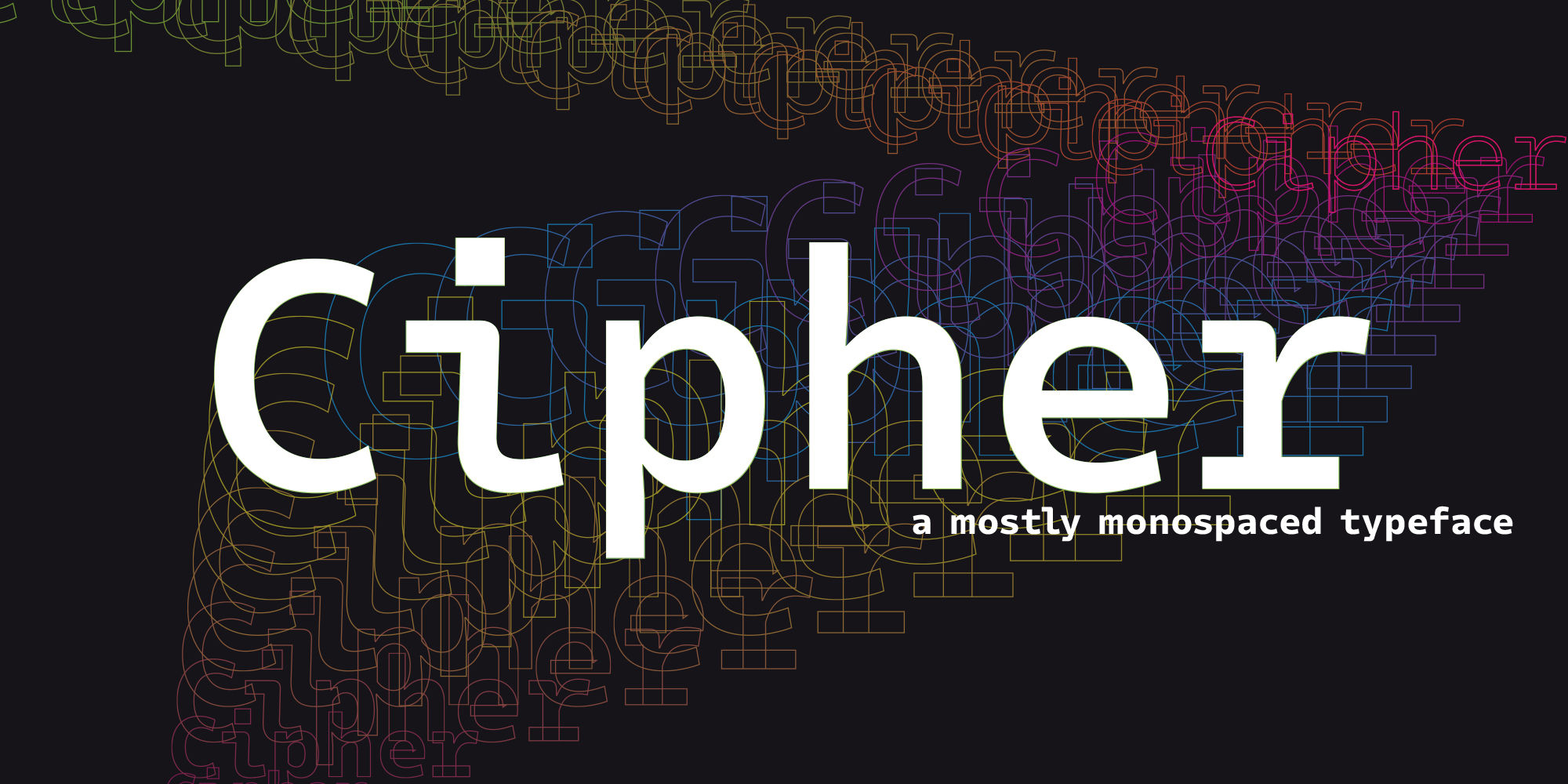
Cipher

Designer:Neil Summerour
Initial Release:2026
Styles:16
Available Writing Systems
Hacking
Weight200
Pssst… you can edit the variable specimen.
Available Styles
ExtraLightExtraLight ItalicLightLight ItalicRegularItalicMediumMedium ItalicSemiBoldSemiBold ItalicBoldBold ItalicExtraBoldExtraBold ItalicBlackBlack Italic
OpenType Features
ON
x4+y9=z23
Superscriptsups
ON
CO3 H2SO4
Scientific Inferiorssinf
ON
No 1st Hk
Ordinalsordn
ON
0123456789
Oldstyle Numeralsonum
ON
Stylistic Set 4ss04
cipher-poster-Cipher-2x1-05-5e229df7.jpg
cipher-poster-Cipher-hero-2x1-5f11d9f3.jpg
cipher-poster-Cipher-2x1-01-6b987c34.jpg
cipher-poster-Cipher-2x1-02-1576d8ed.jpg
cipher-poster-Cipher-2x1-03-3aa8cd38.jpg
cipher-poster-Cipher-2x1-04-7b6070d8.jpg
cipher-poster-Cipher-2x1-05-5e229df7.jpg
cipher-poster-Cipher-hero-2x1-5f11d9f3.jpg
cipher-poster-Cipher-2x1-01-6b987c34.jpg
cipher-poster-Cipher-2x1-02-1576d8ed.jpg
cipher-poster-Cipher-2x1-03-3aa8cd38.jpg
cipher-poster-Cipher-2x1-04-7b6070d8.jpg
cipher-poster-Cipher-2x1-05-5e229df7.jpg
cipher-poster-Cipher-hero-2x1-5f11d9f3.jpg
Specimens
ExtraLight72px
Šifrování změnilo dějiny
Light72px
Günlük şifreleme işlemleri
Regular72px
Krypteringsløsninger 2026
Medium72px
Każdy węzeł ma swój klucz
SemiBold72px
Ağ güvenliği başlıyor şim
Bold72px
Đường truyền được mã hóa
ExtraBold72px
Ξεκλείδωμα νέων δεδομένων
Black72px
Зашифрованный поток данных
LightItalic36px
Every encryption protocol begins with a simple premise: information has value, and value requires protection. From the earliest substitution ciphers to modern elliptic-curve cryptography, the discipline has evolved alongside the threats it counters. Cipher was designed in that spirit, a typeface built for environments where precision and clarity are not optional.
Italic36px
Współczesne systemy kryptograficzne opierają się na złożoności matematycznej. Każdy klucz, każdy węzeł, każde połączenie w sieci wymaga niezawodnej czytelności. Cipher dostarcza tę czytelność w ośmiu gramaturach, od Thin do Black, z rozszerzonym zestawem znaków obejmującym język polski, czeski, wietnamski i dziesiątki innych.
Medium Italic36px
Στο ψηφιακό τοπίο, κάθε χαρακτήρας μετράει. Η σαφήνεια δεν είναι πολυτέλεια αλλά ανάγκη. Ο σχεδιασμός του Cipher αντιμετωπίζει αυτήν την πρόκληση: ψευδο-μονοδιάστατο πλάτος που μοιάζει σταθερό αλλά αναπνέει εκεί που χρειάζεται, με πλήρη ελληνική και κυριλλική υποστήριξη.
Medium14px
The terminal prompt blinks, waiting. It is one of the most familiar sights in computing, that patient cursor against a dark background, ready to accept whatever instruction comes next. For decades, the typefaces that populate this environment have been true monospaced designs, every character occupying the same fixed width regardless of its natural proportions. This approach works. Columns align. Code indents predictably. Tabular data reads cleanly. But it comes at a cost that most users have simply learned to accept. That cost is readability. When every character is forced into the same horizontal space, the letterforms that need more room get compressed and the letterforms that need less get stretched. The result is a subtle but persistent friction, a typeface that serves the grid at the expense of the glyphs. This friction accumulates over hours of reading, particularly in long-form technical documentation and dense code reviews where the eye needs every advantage it can get. Cipher was designed to address this friction without abandoning the grid. The approach is straightforward: start with a monospace foundation where the majority of characters share a common width, then selectively release the characters that suffer most under that constraint. The lowercase m, w, and their accented variants occupy the space their forms actually require. So do the widest Cyrillic characters. The difference is measured in dozens of units, not hundreds, enough to resolve the compression artifacts that plague true monospace designs without disrupting the columnar rhythm. The numerals, where fixed width matters most, remain strictly monospaced. A zero and a one occupy exactly the same horizontal space, ensuring clean alignment in code, data tables, and financial documents. This selective approach to the monospace convention is what makes Cipher a practical tool rather than a theoretical exercise. It solves the problem where it exists and preserves the convention where it works.
Regular12px
Language support in a typeface is often presented as a number, a count of characters or a list of covered scripts, as though quantity alone determines usefulness. The reality is more nuanced. Supporting a language means more than including its Unicode codepoints. It means handling the diacritical combinations that the language actually uses, providing the localized glyph variants that native readers expect, and ensuring that the spacing and positioning of those marks is precise enough to be invisible. Cipher covers the Latin script in depth that extends well beyond the Western European baseline. The full Latin Extended-A block is present, unlocking Central and Eastern European languages: Polish with its ogonek and kreska accents, Czech and Slovak with their caron and acute marks, Hungarian with its double-acute vowels, Romanian with its comma-below diacritics. Latin Extended-B and Latin Extended Additional push further into Vietnamese, which demands some of the most complex stacking diacriticals in any Latin-based orthography, Pinyin romanization for Mandarin Chinese, and a range of African and indigenous languages that depend on characters like the schwa, the eng, and the open-o. Greek coverage extends across the modern Greek alphabet. Cyrillic support covers Russian, Ukrainian, Bulgarian, Serbian, and several Central Asian languages, including characters like the Cyrillic zhe with descender that serve Tatar and Bashkir. Fourteen currency symbols, from the euro and pound to the Vietnamese dong, Indian rupee, and Bitcoin sign, round out the international utility. This breadth of support matters because the environments where Cipher is most useful, code editors, technical documentation, data dashboards, terminal interfaces, are inherently multilingual. A developer in Warsaw, a data analyst in Hanoi, a systems administrator in Athens should each find their native language rendered with the same care as English. That is the standard Cipher is built to meet.
Medium10px
There is a design philosophy embedded in the monospace tradition that deserves examination. The fixed-width grid was born from mechanical necessity. Early typewriters used monospace because the carriage mechanism advanced by a fixed increment after each keystroke. The teletype machines that followed inherited the constraint. When computers arrived, the terminals that displayed their output adopted monospace because the character-cell display architecture demanded it. At no point in this lineage was a designer consulted about whether uniform width was the best approach for reading. It was simply the only approach the hardware could support. The typographic tradition that grew from this mechanical limitation eventually developed its own aesthetic identity. Programmers came to associate the monospace grid with precision, with the seriousness of code, with the authority of the command line. These associations are valid, and Cipher preserves them. But it also acknowledges that the original constraint was technological, not typographic, and that modern rendering engines have no trouble displaying characters at varying widths within a coherent visual system. The pseudo-monospace approach is not new. Several typefaces have explored the space between monospace and proportional. What distinguishes Cipher is the deliberateness of its execution. The deviation from fixed width is not arbitrary. Each character's width was evaluated against the 600-unit baseline, and adjustments were made only where the fixed width demonstrably harmed the letterform. The lowercase m and w, whose three and two diagonal strokes respectively cannot compress to 600 units without visible distortion, received the most significant adjustments. The comma and period, which occupy a tiny fraction of their allotted space in true monospace, were narrowed to reduce the gap they create in running text. This calibration serves a practical purpose. Cipher produces tighter line lengths than true monospace at the same point size, which means more code per screen, more data per row, and more text per page.
Regular8px
The complete box drawing and block element character sets in Cipher are not decorative additions. They are functional tools that serve a specific and growing category of software: terminal user interfaces. Over the past decade, the terminal has experienced a renaissance. Tools like lazygit, htop, and dozens of TUI frameworks have transformed the command line from a text-only environment into a richly structured visual space, rendered entirely in Unicode characters. Box drawing characters, the set of 128 glyphs at U+2500 through U+257F, provide the lines, corners, and intersections that form the borders and dividers of these interfaces. Block elements, the 32 glyphs at U+2580 through U+259F, provide the shaded and partial-block characters used for progress bars, histograms, and density displays. When these characters are missing or poorly aligned in a monospace typeface, TUI applications break visually. Borders show gaps. Progress bars stutter. The careful structure that the developer built with Unicode becomes a mess of misaligned fragments. Cipher includes the complete set of both blocks, and their widths and vertical metrics are calibrated to connect seamlessly at the monospace grid. A horizontal box drawing line in one cell meets the line in the adjacent cell without a gap or an overlap. Vertical lines align from row to row. Corner pieces connect cleanly. This sounds elementary, but it requires precise control of the sidebearings and vertical positioning that many typefaces neglect because box drawing characters are seen as an afterthought. The geometric shapes block provides additional utility: filled and outlined circles, squares, triangles, and diamonds that serve as bullet points, status indicators, and chart elements in terminal and documentation contexts. Combined with the 14 currency symbols and the mathematical operators, Cipher provides the complete symbolic vocabulary that modern technical environments demand.
Description

Cipher is a pseudo-monospace typeface that looks and feels like a fixed-width design but quietly breaks the grid where it matters. Most characters sit at a shared 600-unit width, preserving the columnar rhythm that makes monospace readable. Characters that suffer under fixed-width constraint, the lowercase m, w, and Cyrillic zhe among them, have been given room to breathe. The numerals remain strictly monospaced, where alignment matters most.

The result saves horizontal line length compared to true monospace without sacrificing the visual consistency developers and designers depend on. Eight weights from Thin to Black with matching italics, two variable fonts, and 1,444 glyphs covering extensive Latin, Greek, Cyrillic, Vietnamese, Turkish, Romanian, and 14 currency symbols. Complete box drawing and block element sets for terminal environments. Cipher was built for the spaces where code meets communication.

Supported Languages
413 Supported Languages
ABQAbaza
ACZAcheron
ACEAchinese
ACHAcholi
ACUAchuar-Shiwiar
ADYAdyghe
AARAfar
AFRAfrikaans
AGXAghul
AGRAguaruna
AHTAhtna
AINAinu
GAHAlekano
ALEAleut
ALQAlgonquin
EMSAlutiiq
AMCAmahuaca
AMRAmarakaeri
AMIAmis
ANWAnaang
DGLAndaandi
ANIAndi
AUDAnuta
NJOAo Naga
APNApinayé
ARGAragonese
AAEArbëreshë Albanian
AATArvanitika Albanian
CNIAsháninka
PRQAshéninka Perené
AIIAssyrian Neo-Aramaic
ASTAsturian
ASAAsu
TAYAtayal
AVAAvaric
BANBalinese
RMNBalkan Romani
BJNBanjar
BFABari
BAKBashkir
EUSBasque
BTDBatak Dairi
BTXBatak Karo
BTMBatak Mandailing
BTSBatak Simalungun
BBCBatak Toba
BELBelarusian
BEMBemba
BEZBena
BIKBikol
BINBini
BISBislama
GAXBorana-Arsi-Guji Oromo
BOSBosnian
BREBreton
BDKBudukh
BUGBuginese
BULBulgarian
CBUCandoshi-Shapra
COTCaquinte
HNSCaribbean Hindustani
CBRCashibo-Cacataibo
CBSCashinahua
CATCatalan
CEBCebuano
AYRCentral Aymara
CKBCentral Kurdish
CBIChachi
CJIChamalal
CHAChamorro
CBKChavacano
CHEChechen
CICChickasaw
CGGChiga
CSAChiltepec Chinantec
BXUChina Buriat
CJKChokwe
CHKChuukese
CHVChuvash
CIMCimbrian
CONCofán
SWCCongo Swahili
CORCornish
COSCorsican
MUSCreek
CRHCrimean Tatar
HRVCroatian
DANDanish
DARDargwa
DHVDehu
DIQDimli
DNGDungan
NLDDutch
AAQEastern Abnaki
AEREastern Arrernte
HAEEastern Oromo
EFIEfik
EBUEmbu
ENGEnglish
MYVErzya
ESEEse Ejja
EPOEsperanto
CFMFalam Chin
FAOFaroese
FIJFijian
FILFilipino
FINFinnish
FRAFrench
FURFriulian
GQAGa'anda
GAGGagauz
GLGGalician
GANGan Chinese
LUGGanda
CABGarifuna
DEUGerman
ALNGheg Albanian
GILGilbertese
GOMGoan Konkani
GNIGooniyandi
GUXGourmanchéma
GCFGuadeloupean Creole French
GUZGusii
GWIGwichʼin
HATHaitian
CNHHakha Chin
KHKHalh Mongolian
HAAHan
HNIHani
HAWHawaiian
HILHiligaynon
WINHo-Chunk
HOPHopi
HUSHuastec
ISLIcelandic
IDOIdo
IBOIgbo
ILOIloko
SMNInari Sami
INDIndonesian
INHIngush
IGSInterglossa
INAInterlingua
ILEInterlingue
GLEIrish
RUOIstro Romanian
ITAItalian
MZIIxcatlán Mazatec
JAMJamaican Creole English
JPNJapanese
JAVJavanese
DYOJola-Fonyi
JDTJudeo-Tat
QUCK'iche'
KBDKabardian
KEAKabuverdianu
KGPKaingang
MWPKala Lagaw Ya
KALKalaallisut
KLNKalenjin
XALKalmyk
KAMKamba
KQNKaonde
CAKKaqchikel
KAAKara-Kalpak
KRCKarachay-Balkar
KPTKarata
KRLKarelian
CSBKashubian
KAZKazakh
KEKKekchí
XNZKenzi
KHAKhasi
KIKKikuyu
KMBKimbundu
KINKinyarwanda
KIRKirghiz
KIUKirmanjki
KTUKituba
KOIKomi-Permyak
KPVKomi-Zyrian
KONKongo
KOOKonzo
KUAKuanyama
KUMKumyk
FKVKven Finnish
KSHKölsch
LLDLadin
LADLadino
LBELak
LTGLatgalian
LATLatin
LEZLezghian
LIJLigurian
LITLithuanian
LMOLombard
NDSLow German
DSBLower Sorbian
LOZLozi
LUALuba-Lulua
SMJLule Sami
LUOLuo
LUSLushai
LTZLuxembourgish
RUPMacedo-Romanian
MADMadurese
VMWMakhuwa
MGHMakhuwa-Meetto
KDEMakonde
YMKMakwe
MLGMalagasy
ZLMMalay
MLTMaltese
MNKMandinka
MFVMandjak
KNFMankanya
GLVManx
SWBMaore Comorian
MRIMaori
ARNMapudungun
MCFMatsés
RUQMegleno Romanian
ULKMeriam Mir
MERMeru
OTEMezquital Otomi
XRGMinang
MINMinangkabau
MWLMirandese
ELLModern Greek
MOHMohawk
MDFMoksha
BXMMongolia Buriat
MOEMontagnais
CNRMontenegrin
MFEMorisyen
UMUMunsee
MWFMurrinh-Patha
TTTMuslim Tat
WMWMwani
MIQMískito
NAGNaga Pidgin
NDONdonga
NAPNeapolitan
ZDJNgazidja Comorian
NIUNiuean
FIANobiin
NOGNogai
NOTNomatsiguenga
AZJNorth Azerbaijani
MRQNorth Marquesan
NDENorth Ndebele
KMRNorthern Kurdish
HEANorthern Qiandong Miao
SMENorthern Sami
UZNNorthern Uzbek
OJBNorthwestern Ojibwa
NORNorwegian
NOVNovial
NYANyanja
NYNNyankole
OCIOccitan
CHJOjitlán Chinantec
NONOld Norse
OMAOmaha-Ponca
ORCOrma
ORHOroqen
OSSOssetian
LOTOtuho
PAUPalauan
PLZPaluan
PAMPampanga
TOPPapantla Totonac
PAPPapiamento
NSOPedi
PCDPicard
CPUPichis Ashéninka
PMSPiemontese
PISPijin
PIUPintupi-Luritja
PPLPipil
SJEPite Sami
PONPohnpeian
POLPolish
PNTPontic Greek
PORPortuguese
POTPotawatomi
PRGPrussian
TSZPurepecha
PBBPáez
QUEQuechua
RARRarotongan
RONRomanian
ROHRomansh
ROORotokas
RUNRundi
BXRRussia Buriat
RUSRussian
RUERusyn
RUTRutul
RWKRwa
SAQSamburu
SMOSamoan
SAGSango
SBPSangu
SRMSaramaccan
SRDSardinian
SCOScots
GLAScottish Gaelic
SEYSecoya
SEHSena
SRPSerbian
SEISeri
CRSSeselwa Creole French
KSBShambala
SJWShawnee
SHPShipibo-Conibo
SNAShona
JIVShuar
SGHShughni
SCNSicilian
SZLSilesian
SLKSlovak
SLVSlovenian
XOGSoga
SOMSomali
SNKSoninke
AZBSouth Azerbaijani
MQMSouth Marquesan
NBLSouth Ndebele
AYCSouthern Aymara
HMSSouthern Qiandong Miao
SMASouthern Sami
SOTSouthern Sotho
SPASpanish
SRNSranan Tongo
EKKStandard Estonian
LVSStandard Latvian
ZSMStandard Malay
SUNSundanese
SWHSwahili
SSWSwati
SWESwedish
GSWSwiss German
TABTabassaran
TGLTagalog
TAHTahitian
DAVTaita
TGKTajik
TLYTalysh
TATTatar
CTDTedim Chin
TEOTeso
TETTetum
TDTTetun Dili
TCATicuna
TIVTiv
TLITlingit
TOBToba
TPITok Pisin
TKLTokelau
TOKToki Pona
TONTonga
TOITonga
ALSTosk Albanian
MTOTotontepec Mixe
TKRTsakhur
TSOTsonga
TSNTswana
TUMTumbuka
TURTurkish
TUKTurkmen
TVLTuvalu
TYVTuvinian
TZHTzeltal
TZOTzotzil
AOZUab Meto
UIGUighur
UKRUkrainian
UMBUmbundu
SJUUme Sami
POVUpper Guinea Crioulo
HSBUpper Sorbian
VECVenetian
VEPVeps
VIEVietnamese
VOLVolapük
VROVõro
WLSWallisian
WLNWalloon
WAEWalser
WYBWangaaybuwan-Ngiyambaa
AUCWaorani
WARWaray
WBPWarlpiri
GUCWayuu
CYMWelsh
GAZWest Central Oromo
ABEWestern Abnaki
FRYWestern Frisian
WIMWik-Mungkan
WRHWiradjuri
WOLWolof
XAVXavánte
XHOXhosa
AMEYanesha'
YAOYao
YAPYapese
YIJYindjibarndi
YORYoruba
YUAYucateco
ZULZulu
ZUNZuni
ZROZáparo
Language support is predicted based on codepoint coverage and not guaranteed to be accurate.
Glyphs
Medium
U+0041 / A
Outlines
660CH
488XH
0BL
Latin Uppercase26
A
B
C
D
E
F
G
H
I
J
K
L
M
N
O
P
Q
R
S
T
U
V
W
X
Y
Z
Latin Lowercase26
a
b
c
d
e
f
g
h
i
j
k
l
m
n
o
p
q
r
s
t
u
v
w
x
y
z
Latin Uppercase Accented202
À
Á
Â
Ã
Ä
Å
Ā
Ă
Ą
Ǎ
Ǻ
Æ
Ǣ
Ǽ
Ƀ
Ç
Ć
Ĉ
Ċ
Č
Ď
Đ
Ð
Ɗ
È
É
Ê
Ë
Ē
Ĕ
Ė
Ę
Ě
Ə
Ĝ
Ğ
Ġ
Ģ
Ǧ
Ǵ
Ɠ
Ĥ
Ħ
Ì
Í
Î
Ï
Ĩ
Ī
Ĭ
Į
İ
Ǐ
IJ
Ĵ
Ķ
Ĺ
Ļ
Ľ
Ł
Ŀ
Ñ
Ń
Ņ
Ň
Ǹ
Ŋ
Ò
Ó
Ô
Õ
Ö
Ō
Ŏ
Ő
Ơ
Ǒ
Ǫ
Ø
Ǿ
Œ
Ŕ
Ŗ
Ř
Ś
Ŝ
Ş
Š
Ș
Ţ
Ť
Ț
Ŧ
Ù
Ú
Û
Ü
Ũ
Ū
Ŭ
Ů
Ű
Ų
Ư
Ǔ
Ǖ
Ǘ
Ǚ
Ǜ
Ŵ
Ý
Ŷ
Ÿ
Ź
Ż
Ž
Þ
Latin Lowercase Accented279
à
á
â
ã
ä
å
ā
ă
ą
ǎ
ǻ
æ
ǣ
ǽ
ɐ
ɑ
ɒ
ʙ
ƀ
ɓ
ç
ć
ĉ
ċ
č
ɕ
ď
đ
ð
ʤ
ɖ
ɗ
è
é
ê
ë
ē
ĕ
ė
ę
ě
ế
ə
ɛ
ɘ
ɚ
ɜ
ɞ
ɤ
ƒ
ĝ
ğ
ġ
ģ
ǧ
ǵ
ɡ
ɢ
ɠ
ɣ
ĥ
ħ
ʜ
ɦ
ɧ
ì
í
î
ï
ĩ
ī
ĭ
į
ı
ǐ
ij
ɪ
ɨ
ĵ
ȷ
ʝ
ɟ
ʄ
ķ
ʞ
ĺ
ļ
ľ
ł
ŀ
ʟ
ɫ
ɬ
ɭ
ɮ
ʎ
ḿ
ɱ
ñ
ń
ņ
ň
ǹ
ɴ
ɲ
ɳ
ŋ
ò
ó
ô
õ
ö
ō
ŏ
ő
ơ
ǒ
ǫ
ø
ǿ
œ
ɶ
ɔ
ɵ
ɸ
ĸ
ŕ
ŗ
ř
ʀ
ɹ
ɺ
ɻ
ɽ
ɾ
ʁ
ś
ŝ
ş
š
ſ
ș
ß
ʂ
ʃ
ţ
ť
ț
ʦ
ʧ
ŧ
ʈ
ʇ
ù
ú
û
ü
ũ
ū
ŭ
ů
ű
ų
ư
ǔ
ǖ
ǘ
ǚ
ǜ
ʉ
ɥ
ɯ
ɰ
ʊ
ṿ
ʋ
ʌ
ŵ
ʍ
ý
ÿ
ŷ
ʏ
ź
ż
ž
ʐ
ʑ
ʒ
þ
ʔ
ʼn
ʕ
ʡ
ʢ
ʘ
Numerals10
0
1
2
3
4
5
6
7
8
9
Currency25
$
¢
£
¤
¥
฿
Fractions18
¼
½
¾
Punctuation & Symbols90
!
"
#
%
&
'
(
)
*
+
,
-
.
/
:
;
<
=
>
?
@
[
\
]
^
_
`
{
|
}
~
¡
¦
§
©
ª
«
¬
®
°
±
²
³
µ
·
¹
º
»
¿
Mathematical Symbols39
×
÷
Superscript & Subscript23
Geometric Shapes & Misc53
Greek Uppercase24
Α
Β
Γ
Δ
Ε
Ζ
Η
Θ
Ι
Κ
Λ
Μ
Ν
Ξ
Ο
Π
Ρ
Σ
Τ
Υ
Φ
Χ
Ψ
Ω
Greek Lowercase25
α
β
γ
δ
ε
ζ
η
θ
ι
κ
λ
μ
ν
ξ
ο
π
ρ
ς
σ
τ
υ
φ
χ
ψ
ω
Greek Accented48
;
·
᾿
ʹ
͵
Ά
ά
ϐ
Έ
έ
ϝ
ϛ
Ή
ή
ϑ
Ί
ΐ
Ϊ
ί
ϊ
ϗ
Ό
ό
ϙ
Ύ
Ϋ
ΰ
ϋ
ύ
ϕ
Ώ
ώ
ϡ
Cyrillic Uppercase48
Ѐ
Ё
Ђ
Ѓ
Є
Ѕ
І
Ї
Ј
Љ
Њ
Ћ
Ќ
Ѝ
Ў
Џ
А
Б
В
Г
Д
Е
Ж
З
И
Й
К
Л
М
Н
О
П
Р
С
Т
У
Ф
Х
Ц
Ч
Ш
Щ
Ъ
Ы
Ь
Э
Ю
Я
Cyrillic Lowercase48
а
б
в
г
д
е
ж
з
и
й
к
л
м
н
о
п
р
с
т
у
ф
х
ц
ч
ш
щ
ъ
ы
ь
э
ю
я
ѐ
ё
ђ
ѓ
є
ѕ
і
ї
ј
љ
њ
ћ
ќ
ѝ
ў
џ
Cyrillic Extended54
Ѣ
ѣ
Ѳ
ѳ
Ѵ
ѵ
Ґ
ґ
Ғ
ғ
Җ
җ
Ҙ
ҙ
Қ
қ
Ҡ
ҡ
Ң
ң
Ҫ
ҫ
Ү
ү
Ұ
ұ
Ҳ
ҳ
Ҷ
ҷ
Һ
һ
Ӏ
Ӂ
ӂ
ӏ
Ӑ
ӑ
Ӕ
ӕ
Ӗ
ӗ
Ә
ә
Ӣ
ӣ
Ӧ
ӧ
Ө
ө
Ӯ
ӯ
Ӳ
ӳ
Number Forms1
Box Drawing & Block Elements160
Alternates1
Denominators14
Fractions2
Standard Ligatures2
Numerators14
Oldstyle Figures10
Ordinals10
Stylistic Set 041
Subscript Alternates2
Superscript Alternates6
This typeface contains a total of 1283 glyphs
Hi! Positype uses essential cookies to keep checkout and your session working, and, with your permission, Google Analytics to understand how the site is used. Essential cookies are always on; analytics is your choice.